

It will get this big! (Does he mean the little girl or the Pagoda dogwood?)


.


A couple compares the Canopy Coverage of Arlington’s Civic Associations
It will get this big! (Does he mean the little girl or the Pagoda dogwood?)
.
A couple compares the Canopy Coverage of Arlington’s Civic Associations

Stephanie Juchs, community education coordinator for Casey Trees, on Sept. 14, led an advanced training session of tree identification at the organization’s Washington, D.C. location.
Some interesting take aways offered by participants:
– The Paw Paw Tree (Asimina triloba) produces the largest native fruit in North America.
– For every 1 inch of caliper a tree needs about 1 year to become established: A 6-inch caliper tree, then, needs six years to make itself at home. The implications of this are enormous for the homeowner. Who wants to water a tree week in and week out for six lo-o-o-o-ng years? Plant a whip and it settles in far quicker, freeing up a homeowner to pursue more interesting activities. That’s a big advantage to planting smaller trees — much like the ones the county is offering for the tree giveaway.
What’s a happy medium? A 2-inch caliper tree.
Arlington, Virginia is an urban county with 62% of its housing stock being multi-family apartments, condominiums, or home owner associations — but that doesn’t mean those residents can’t take advantage of the free tree distribution on October 15 and 19th.
This year, multi-family housing groups can pick out native trees to take “home” and plant. All you need to do is get permission from the appropriate authority (Greens committee, apartment house manager, board, etc.) and contact info@TreeStewards.org. A TreeSteward volunteer will assist in selecting the best species for your location and tell you how to reserve your choice on-line.
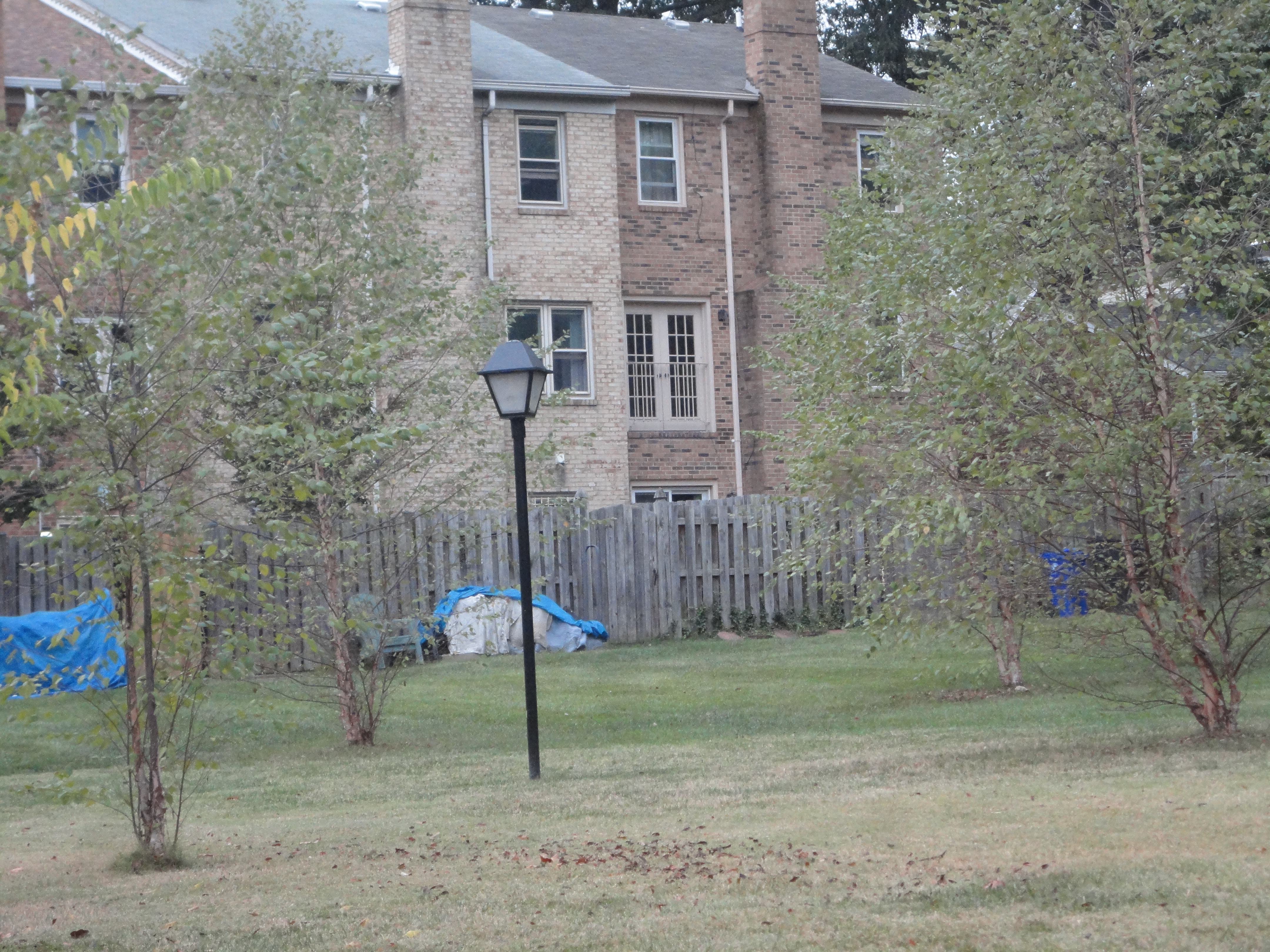
River birches at Westwind HOA were planted three years ago as tiny whips.
Think these small whips won’t make a difference? Westwind HOA in North Arlington had a large common area in full sun that regularly turned into a wet, unappealing spot. In 2010 their grounds committee chose several River birches and held a get-to-know-your-neighbors planting event, and residents signed up for watering duty to ensure the trees survived. The trees are more than 20 feet high now, as well as helping keep the field dry. The commons area is now a pleasant place.
We’d love to help other condo and apartment dwellers plant trees in their sites. Contact us at info@TreeStewards.org Hurry, trees are going fast and may be gone by pick up day.
Single Family Houses can reserve their tree directly at https://environment.arlingtonva.us/register-for-your-free-tree/

TreeSteward asistng in selecting the right tree for their yard.

This lovely Pagoda dogwood is better than a licorice stick!

Earth Sangha nursery depends on dedicated volunteers.
Abby Farms Nursery in nearby Indian Head, Maryland was a good example of large scale nursery production since it is one of the Dennison Nursery companies. They have a wide selection of cultivar trees and some straight native species. The nursery comprises numerous greenhouses, large plantations, mountains of mulch, and lake that recycles irrigation water.
Clear Ridge Nursery near Westminster, Maryland took us back to the family farm days. The owner and his family live in a fine old house surrounded by ancient trees, and farther afield are acres of the young tree plantations. Imagine waking up each morning to very happy birds who have a choice of twenty different tree species to eat from.
Now imagine the active discussion of six different tree lovers who had to choose which tree species from which nurseries were best for the Arlington yards? We chose three large canopy trees: Sweet birch, White oak and Black gum and three smaller trees: Black haw, Sweetbay magnolia, and Pagoda dogwood. (More details on each species and how to apply coming soon)
We learned a great deal on how trees are grown, and how to judge quality of the young trees. But really, it was like being asked to help Santa by choosing the best in a candy store.
 The banyan tree (Ficus bengalensis) close to Cambodia’s famed Ta Prohm temple is a horticultural wonder. Part of the Moraceae family, banyan hails from India and tropical Africa. But it is most noted for its genesis: Birds, which eat the banyan’s fig-like fruit, drop the seeds into the canopy of other trees. The seeds grow into an epiphyte; that is, a plant that uses another plant as a mechanical support.
The banyan pulls its nourishment and water from the air, leading the nascent banyan tree to develop branches. These descend laterally and once in contact with the earth develop a root system underground to become the trunks of the tree. Over time, the banyan strangles the host tree.
The banyan tree’s wood is soft and porous and the plant exudes a white sticky sap that is about three percent latex, which can be used to make rubber. At his winter estate in Florida Thomas Edison explored the possibility of using the tree to produce rubber for American industry and defense. Eventually Edison concluded the banyan was too slow growing and he turned instead to goldenrod, which also produces latex, perfecting a 10-foot tall hybrid. The synthetic chemical industry, however, soon put the Edison Botanic Corporation out of business. (Photo by Lynn Koch)
 As this Ficus tree shows, it’s an arboreal free for all in the jungles of Cambodia. So bring along your torch and compass to explore the Cambodian temple Ta Prohm. Archeologists reckon the temple was constructed sometime between the mid-12th century and early 13th century by King Jayavarman VII, a Buddhist. The Bayon-style temple is dedicated to the mother of the king. Ta Prohm is hailed as the Kingdom of Trees.
The Ficus genus includes more than 800 species, many of which produce fig fruit. Fig trees are keystone species in many rainforest ecosystems and nourish a host of animals, including fruit bats, capuchin monkeys, langurs, Asian barbets, pigeons, hornbills, fig-parrots and bulbuls. (Photo by Lynn Koch).
 Bark of Rainbow Eucalyptus tree (Eucalyptus deglupta) in Costa Rica. Tree guru Michael Dirr calls the bark “one of the biological world’s great treasures.” The colors of the bark are due to the way patches of it shed at different times throughout the year, revealing a bright green inner bark that darkens to blue, purple, orange and maroon as it matures. The tree is harvested for pulpwood to make paper, especially in tropical areas. (Photo by Lynn Koch)

 Yes indeed: Trees do the darnedest things! This photo of one of Oregon’s local arboreal celebrities comes to us by way of Lynn Koch. The Douglas Fir and The Living Stump are located in the southern portion of the state near the Rogue River.
 This hulking creature has been dubbed — appropriately enough — The Big Tree. It stands not far from the Zambezi River above Victoria Falls in Zimbabwe. It would have been standing there when Scottish explorer David Livingstone (of the “Dr. Livingstone, I presume?” fame) in the mid-1800s renamed a glorious waterfall in Africa that he had come across after Victoria, Britain’s monarch at the time.
The sign identifies this as a Baobab tree (Adansonia digitata). Its girth comes in at 18 meters (59 feet), its height a whopping 25 meters (82 feet). It came into being sometime between 1,000 and 1,500 years ago. The tree blooms in early summer, which in Zimbabwe runs from November to March. (Photo by John Wingard)
 This Baobab tree looms at the center of a village in the narrow strip of Namibia that is north of Botswana, near Chobe National Park. Tourists flock here to stay at the lodges on the banks of the Chobe River, just outside the park. (Photo by John Wingard)


Click the image for tips on caring for mature trees.
