Prevention through Education: The Home Show Strategy

The map showing tree canopy percentage was a big draw.

The map showing tree canopy percentage was a big draw.

Too often the first inkling of construction in our neighborhoods is the day the trees come down — but could this be prevented by education to the construction companies and residents planning to remodel or build a new house?

TreeStewards and the Arlington County Urban Forestry Commission tested this theory on March 8, 2014 at the Arlington Home Show. The information booth featured a large map divided into civic association areas with the tree canopy percentage shown for each so residents could compare theirs to the county average of 41%, and a sign advertising the Tree Canopy Fund.  The response was great! Over 150 individuals had conversations with those staffing the booth and many more picked up tree care materials.  We answered questions on best time to plant trees, how to select an arborist, and especially ways to prevent tree damage during construction.

Outreach to other exhibitors was also accomplished by TreeSteward John Wingard who visited vendors who often impact trees: landscapers, hardscape designers, deck builders, addition builders, remodelers and realty companies.  The brochures Avoiding Tree Damage During Construction and Treatment of Trees Damaged by Construction were provided. Builders who did larger projects of multiple houses were also engaged in a discussion of county permitting procedures that might provide flexibility in preserving trees and contacts were made for future discussions.

Finding ways to preserve trees in the midst of a building boom is challenging but necessary. We don’t know the final impact of our education at the Home Show, but we successfully reached an audience that does have ongoing impacts on trees.

If you’d like to join the small group studying ways to reform permitting and zoning, plant a seed in our comment box farther down to the right.

Posted in Advocacy, Community Service, Events | Tagged , | Comments Off on Prevention through Education: The Home Show Strategy

Shark Attack Fears and Tree Survival

SharksDid you know that people at the beach are more worried about a Shark Attack than they are about a car accident during the long drive to and from the beach?  Guess which has a higher probability?

We learned that fact last week at the Urban Forestry Roundtable on “Disaster Planning, Response and Recovery.” Trees are a valuable community asset, but when weather strikes they can become a problem. Turns out the best way to prevent such problems is our favorite mantra: Plant the Right Tree in the Right Place.  Ensuring large trees won’t be halved by utility companies because they grow into wires, or squeezed between a house and driveway with no root space avoids the problem twenty years later.

Thousands of trees didn't come down in the storm! won't make the news headline.

Thousands of trees didn’t come down in the storm! won’t make the news headline.

So what does this have to do with Sharks?  After Hurricane Isabel, Derrecho, Snowmaggedon, and many more storms, people react through fear.  One tree comes down on a neighbor’s house — but they don’t notice the 1,000 other trees that did not lose a single limb. Many people’s gut reaction is to have the tree taken down by those who go door to door offering their services, rather than contacting certified arborists to maintain the tree in a preventive manner.

So let’s be proactive and provide education on tree maintenance and direct our neighbors to qualified tree services.  (See post below)http://treestewards.org/2012/08/24/how-to-select-an-arborist-or-tree-service-company/

Posted in Education, Tree Care | Tagged , , | Comments Off on Shark Attack Fears and Tree Survival

Making a Difference in 2013: 4,000 Trees and 5,000 People

The numbers have been crunched from our on-line reporting system and 64 TreeSteward members reported 3300+ service hours in calendar year 2013. More importantly, we provided education over 5,000 times and worked directly with trees 4,000 times. For statisticians reading this, that’s duplicated counts in that one TreeSteward may have watered the same 10 trees 4 times throughout the late summer drought (trees want duplicated watering!).

TreeStewards Educate People about Trees
We provided tree care information to residents at the Parkfairfax Native Plant Sale, Alexandria Earth Day, Farmers’ Markets at Courthouse, Westover, Falls Church,Del Ray. Tree Stewards provided individual education to more than 400 families who “adopted” tree whips at the fall Tree Distribution Program. TreeStewards participated in Arlington County’s Notable Tree Program with the result that 17 new specimen trees received recognition by the County Board. Neighborhood participation by TreeStewards resulted in six being put on their HOA Boards or greens committee, others wrote articles for community newsletters, and coordinated for the Tree Canopy Fund.

Poster with children viewing

TreeStewards enjoy providing education at community events.


Presence in Cyberspace
Over 12,000 Visitors had 25,236 Views to this website with information on tree care and advocacy for trees. “Take Ivy off Trees” had 900 viewers and groups from around the nation requested permission to use materials or link to our site.

Tree Planting and Maintenance
In Alexandria, Alliance for Community Trees and TD Bank partnered with us to plant 30 trees at Tarleton Park and provided funding to purchase equipment for ongoing projects. Watering of the trees is funded for two summers as well. Casey Trees partnered with us to plant another 25 trees at Four Mile Run Park.

TD Bank employees and TreeStewards planted 30 trees at Tarleton Park on October 15, 2013

TD Bank employees and TreeStewards planted 30 trees at Tarleton Park on October 15, 2013


In Falls Church, TreeSteward members assisted at three weekends of tree planting. In Arlington, twelve members worked through the Arlington Tree Canopy Fund and assisted homeowners and associations in selecting the Right Tree for the Right Place for 400 trees. Habitat restoration by removing invasive plants and planting natives was a core volunteer effort that occurred in each jurisdiction.

Standing Up for Trees
TreeStewards serve on Urban Forestry Commission in Arlington and Tree Commission in Falls Church to advise local governments on tree related issues. A tree census was conducted of forested land beside the W&OD Trail in an effort to preserve the 170 native trees present, with the results circulated at public meetings. Meetings were held with VDOT officials to increase the use of native trees along roadways.

The Learning Never Stops
TreeStewards increased their knowledge through participation at the Quarterly Urban Forestry Roundtables on urban watersheds and tree production, pruning practicum with Arlington County staff, a tree walk at the US Capitol with Alexandria arborist, and tree root exploration with Falls Church arborist. This year Casey Trees kindly invited us to their trainings.

Casey Trees included us in their pruning workshop taught by Barry Stohl, NPS.

Casey Trees included us in their pruning workshop taught by Barry Stohl, NPS.

And now we are training 21 new members to increase our presence in 2014!

Posted in Community Service, Events, Uncategorized | Tagged , | Comments Off on Making a Difference in 2013: 4,000 Trees and 5,000 People

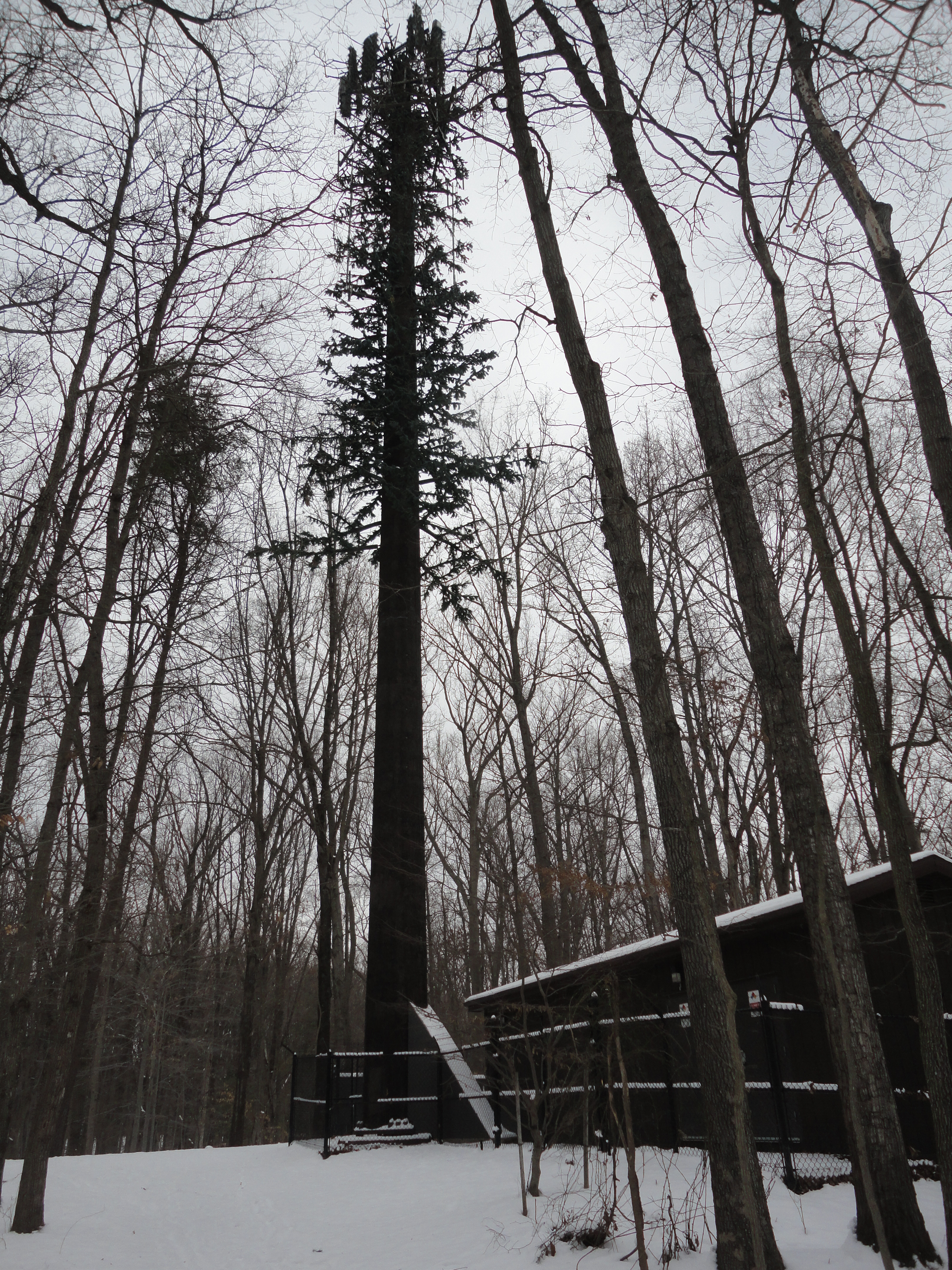
Another Tree Benefit: Good Cell Reception

While hiking in a nearby National Park, I came upon the specimen shown to the right, which was unlike any other tree in this oak/hickory forest.

Note the unusual evergreen branches in this hardwood forest.

Note the unusual evergreen branches in this hardwood forest.


I pulled out my trusty Smartphone App Guide to Trees of North America and started searching. Hmm, the trunk was a dark brown metallic looking color and smooth with no branches until 60 feet in the air. I could see this was an evergreen species with alternate compound leaves. Although the specimen was behind a locked fence, there were bumps all around the base sort of like the knees one sees on some Cyprus trees, although these circular ones resembled nuts and bolts.
The final tip came when I realized how strong reception was on the cell phone. This was most likely Sequoidendrum cellamturrim which has been discretely “planted” along interstates, golf courses, and alongside buildings. Like all non-native trees, we’ll have to be sure it doesn’t become invasive in the future.

Posted in Education | Tagged , | 1 Comment

Return of the Mighty Elm

Barry Stahl, who is responsible for growing American elms for the National Park Service, here instructs TreeStewards and other citizen volunteers on the best way to prune trees to insure good structure and health. These American elms have been grown from seed at a nursery along the Potomac River and are part of an effort to boost on the National Mall the number of native elms, whose numbers were decimated after Dutch Elm disease spread rapidly across the country in the mid-20th century.

On Jan. 11 Barry Stahl, who runs a nursery of American elms for the National Park Service, here uses one of the elms to demonstrate to Tree Stewards and other citizen volunteers  the best way to prune trees to insure good structure and health. These American elms have been grown from seed at the nursery along the Potomac River and are part of an effort to boost on the National Mall the number of native elms, whose numbers were decimated after Dutch Elm disease spread rapidly across the country in the mid-20th century.


Posted in Uncategorized | Comments Off on Return of the Mighty Elm

Is That You, Santa Claus?

No, it wasn't jolly Ol' Saint Nick delivering goodies for under the tree: It was workers from Davey Trees delivering and installing trees for free to all the good people in Arlington who requested them.  Arlingtonians for a Clean Environment administer the increasingly popular Tree Canopy Fund program, which provides free trees and installation to homeowners who participate. The costs of the program is paid for by land developers. TCF is an effort to increase Arlington's tree canopy, which has dwindled sharply over the past 30 years.

No, it wasn’t jolly Ol’ Saint Nick delivering goodies for under the tree: It was workers from Davey Trees delivering and installing trees for free to all the good people in Arlington who requested them.
Arlingtonians for a Clean Environment administer the increasingly popular Tree Canopy Fund program, which provides free trees and installation to participating homeowners. The cost of the program is paid for by land developers. TCF is an effort to increase Arlington’s tree canopy, which has dwindled sharply over the past 30 years.

Posted in Uncategorized | Comments Off on Is That You, Santa Claus?

Miniature Loggers Descend on TreeStewards’ Holiday Party

Body Types Suspiciously Reminiscent of Mr. Peanut
Red Jackets and Flowing Beards Befuddle Onlookers

photo-6
Photo by Jane Longan

Posted in Uncategorized | Comments Off on Miniature Loggers Descend on TreeStewards’ Holiday Party

Bareroot Planting: Coming Soon to a Yard Near You

Falls Church Arborist Ben Thompson explains tree root physiology.

Falls Church Arborist Ben Thompson explains tree root physiology.

On Sunday, Nov. 17 City of Falls Church Arborist Ben Thompson demonstrated at Frady Park how to wash the roots of a tree before planting. It is a relatively new technique that is taking the tree world by storm. The advantages of this technique is that trees are more likely to be planted correctly without girdling roots from containerized trees or without the wire cage and burlap removed from B&B planted trees.

The aim of root washing is to expose the interior of the root ball. Once the soil has been removed — by submerging the root ball in water or by hosing away the soil — “J”-shaped roots and girdling roots can be cut out and fibrous root strands can be arranged to best advantage for the tree.
Root washing may also reveal the tree’s root flare, which should be above grade. Oftentimes in nurseries soil is piled up above the flare, sold and then planted in the landscape without correction. This leads the underground bark to become wet and soggy, a perfect entryway for diseases and pests, and curtails the life of the plant.

Flare is the section of the tree where the trunk turns into the root system. It's wider sloping body should be visible.

Flare is the section of the tree where the trunk turns into the root system. It’s wider sloping body should be visible.

What happens to trees incorrectly planted? This sourwood tree was planted three years ago but failed to thrive so it was excavated as a learning for volunteer tree planters. Surprise! The wire cage and burlap is still visible – a poor planting job confined this tree to the nutrients only in its rootball. Wires and burlap were removed, roots were soaked for 36 hours before the being pulled apart, each root straightened and then carefully replanted using the bare root method. Now that it has been freed and correctly replanted, will it thrive? Check back next year when we update the post.

Note the wire cage and burlap still visible after 3 years.  Poor planting.

Note the wire cage and burlap still visible after 3 years. Poor planting.

Posted in Education, Tree Care | Tagged , | Comments Off on Bareroot Planting: Coming Soon to a Yard Near You

Tree Whips and Whippersnappers

It will get this big! (Does he mean the little girl or the Pagoda dogwood?)

It will get this big! (Does he mean the little girl or the Pagoda dogwood?)

Five hundred young tree whips were distributed to their new Arlington homes on October 26 and a dozen TreeSteward volunteers were present to help families pick out their tree, and learn how to properly plant and care for it. The best part about the event is experiencing the delight of children being among the trees. Here is a selection of photos — many thanks to photographer Bill Anhut and to the parents who allowed the inclusion. kidslove treesgirlselectstreekidonshoulders
.

.

babytreesuccessful adoption
A couple compares the Canopy Coverage of Arlington's Civic Associations

A couple compares the Canopy Coverage of Arlington’s Civic Associations

Posted in Education, Events | Tagged , , | Comments Off on Tree Whips and Whippersnappers

Trees 201: Advanced training for TreeStewards

photo-4
Stephanie Juchs, community education coordinator for Casey Trees, on Sept. 14, led an advanced training session of tree identification at the organization’s Washington, D.C. location.
Some interesting take aways offered by participants:
– The Paw Paw Tree (Asimina triloba) produces the largest native fruit in North America.
– For every 1 inch of caliper a tree needs about 1 year to become established: A 6-inch caliper tree, then, needs six years to make itself at home. The implications of this are enormous for the homeowner. Who wants to water a tree week in and week out for six lo-o-o-o-ng years? Plant a whip and it settles in far quicker, freeing up a homeowner to pursue more interesting activities. That’s a big advantage to planting smaller trees — much like the ones the county is offering for the tree giveaway.
What’s a happy medium? A 2-inch caliper tree.

Posted in Uncategorized | Comments Off on Trees 201: Advanced training for TreeStewards