Save Our Counted Trees from Invasives: February 21, 2015


Forested intersection

County owned parcel of forested land at eastern corner of Walter Reed Dr. and the W&OD Trail

On Saturday morning, February 21, 2015 we will remove invasive plants choking the trees — and practice our winter tree ID skills.  Please don your winter work clothes, bring gloves and clippers and meet us between 9AM and Noon at the intersection of Walter Reed  and Four Mile Run Drive.  Our work saved this forest from development last year, now let’s give the trees more freedom from choking vines.

Below is the original post  from January 2014 describing our efforts counting the trees and educating others of their value:

This forested parcel of land owned by Arlington County is being considered for relocation of the Phoenix Bikes Program and so it was inventoried by members of the Arlington Regional Master Naturalists and TreeStewards to determine the benefits from the trees and impact of tree loss if a building replaced the trees. The wooded parcel of land (about an acre) is located along the Washington and Old Dominion Trail (W&OD Trail) at the intersection of South Four Mile Run Drive and Walter Reed Drive (eastern side of intersection).

A tree inventory is an important scientific, technical, and educational tool. Fieldwork for this tree inventory was initiated December 27, 2013, and completed December 31, 2013. This tree inventory identified the species and diameter of each tree 2 inches or greater in diameter. Tree diameter is usually measured at 4.5 feet (137 cm) above ground level. Measurement at this height is referred to as diameter at breast height or DBH. The volunteer team measured over 200 trees with a DBH of 2 inches or greater. The results show that this parcel of land contains:

• Over 170 trees that are native tree species.
• High species diversity with almost 30 different tree species including: American elm, ash (white and green), black gum, black locust, eastern red cedar, northern red oak, pin oak, red maple, scarlet oak, southern red oak, sweet gum, sycamore, and black cherry.
• More than 120 trees with DBH’s greater than 6 inches.
• Five trees of impressive size and shape: three native oaks, one native ash, and one native sweetgum between 30 and 40 inches DBH. Continue reading

Posted in Advocacy, Community Service, Education | Comments Off on Save Our Counted Trees from Invasives: February 21, 2015

Give a Tree Book for the Holidays

books on shelf arranged to be a treeThe Christmas/Hanukah season has a strong connection to trees. Buying a stately Fraser fir or setting up the synthetic Christmas tree is standard operating procedure for many families at this time of year. Although it is less likely now, dreidels used to be made out of wood, as were many toys of the past. And how about “Over the river and through the WOODS to Grandmothers house we go?” Trees galore! So, how about a book on trees for the holidays, especially for someone who is beginning their journey into the natural world or on the other end of the spectrum for someone who has a deep interest and can’t get enough information? Here are a few Tree Stewards favorites to consider for the newbie tree aficionado or the seasoned veteran on your list.

Sibley bookThe all time go to book for tree lovers is “The Sibley Guide to Trees” by David Allen Sibley.  Sibley is best known for his books on birds and to help bird watchers he decided to write and illustrate a book on trees.  The book has become a classic.  Full of illustrations of trees, leaves. and fruit, it can help you identify many species both in the winter and the summer.

Nora Palmatier, TreeSteward’s president likes “Manual of Woody Landscape Plants: Their Identification, Ornamental Characteristics, Culture, Propogation and Uses” by Michael Dirr.  This is Nora’s go to book because it has information about every common tree and most of their cultivars.  Details that are hard to remember are what it specializes in: rate of growth, diseases and Insects, size, hardiness etc.  This is one tomb of a book (1330 pages), definitely for the serious tree student. If you are thinking of this, be sure and get the hard back copy if you go that route. The paperback copy is not as hardy (no pun intended) and if used too much will fall apart. It is now available on iPads but not on Kindles.

PeppermintWhat about for kids? There are many books introducing children to our natural world and listing all the books would be a book in itself. For something different Rod Simmons, Alexandria’s Natural Resource Specialist, suggests a lovely brand new children’s book, “Isabella’s Peppermint Flowers”. Young readers can learn about Virginia’s colonial history as well as key aspects of botany. The book is available from http://www.floraforkids.org/. All profits will be donated by the author, Susan Leopold, to the Flora of Virginia Project

Locally we are very fortunate to have another newly published book “Field Guide to the Natural World of Washington D.C.” by Howard Youth. This is a beautiful book that not only shares information on local trees but wildlife (from the lowly earthworm to raccoons and deer), plants (even mushrooms) and birds. The book is beautifully illustrated with gorgeous prints that are frame worthy.

Native treesAnother one of our Tree Stewards, Bonnie Petrie, claims her favorite tree book is “Native Trees for North American Landscapes” by Guy Sternberg and Jim Wilson.  According to Bonnie the pictures in this book are “simply gorgeous”.  For someone who is simply seeking to satisfy curiosity that arises during a hike, this book is a winner.

And lastly if you’re looking for inspiration, try Dr. Seuss’s “The Lorax.” Beth Bosecker (a 2014 Tree Stewards graduate) has a favorite quote from the book: “Unless someone like you cares a whole awful lot, nothing is going to get better. It’s not.” This book inspired her when she was young to keep up her interest in nature and trees and it helped in her decision as a young person to move forward in her career as an environmental scientist, a master naturalist, and a tree steward.

The Lorax is an inspiration for all tree lovers

The Lorax is an inspiration for all tree lovers

Hope this scratches an itch and just so you know, I found all these books on either Amazon or ABE books.  Many, if not most, are available digitally as well.

Happy Reading,

TreeSteward Eileen Grant

Posted in Education | Tagged | Comments Off on Give a Tree Book for the Holidays

Continuing Care and ID at Four Mile Run Park

volunteers at hawthorn

Deer guards were wrapped around the trunk of this Hawthorne

Just like human babies, newly planted trees need ongoing care and protection. In April 2013, TreeStewards and Casey Trees planted twenty-five young trees in Four Mile Run Park off Mt. Vernon Avenue.  And over the last two summers, TreeSteward Kurt Moser has filled the water bags as needed and watched over them.  The Hackberry, Redbuds, Hawthorn, Yellowoods, Kentucky Coffeetree, Swamp white oaks, London Plane tree, and American Elm are all doing well and show new growth. Unfortunately the hophornbeam planted closest to the path fatally attracted deer last winter that used the trunks as rubbing posts. Something had to be done to protect the remaining trees!

DSC03518At the fall workday of November 2, TreeStewards removed the summer’s watering bags for winter storage, examined each tree to ensure no trunk damage and wrapped each trunk loosely with a stiff plastic deer guard. Now deer will come in contact with the plastic and not the sensitive bark, we are hoping. The tree guards cost about five dollars each, less than 1% of the value of the trees worth in benefits from clean air and stormwater management so we know it is worth the attempt.

wire cutting into tree trunk

An example of bad staking that used wire: this tree’s trunk will never recover. (TS did not plant this one!)

Note in the photo that these trees were staked although best practice is to allow young trunks to strengthen as they sway with the wind. Also note the ties between trunk and stake is loose to allow this movement. In this particular location, strong winds can blow young trees over before they have established structural roots so staking is necessary the first year. And stakes continue to provide protection from the human element: mowers, weed wackers, dogs, stray soccer balls. What is vitally important is that wires and ties are removed from trunks before they can damage it! These trees are regularly checked and the ties removed as needed.

The trees are beside Alexandria’s Sunday morning Farmers & Artisans Market, and border a popular walking path so it is the ideal place for outdoor education. Eleven tree identification signs were loosely hung on a sample of each species while the remaining fourteen have none. Test your winter tree ID skills by visiting the site and examining the Acer rubra sign – then find the other Red Maple. Then revisit next summer to test your leaf identification skills. Hint: not every species has two specimens and some have more.

ID sign of hawthorne

ID signage was attached loosely around the branch. Park maintenance preferred this method to signage in the ground.

TreeStewards will be holding tree identification walks in the area through the seasons.

Posted in Community Service, Tree Care | Tagged , , | Comments Off on Continuing Care and ID at Four Mile Run Park

Reforesting Post Derecho in Alexandria

Eager recipients came at sunrise to adopt their tree and plant it by noon!

Eager recipients came at sunrise to adopt their tree and plant it by noon!

On Saturday October 18th, Alexandria City saw its first FREE tree give away.  Sponsored by TreeStewards and funded by a grant from ACTrees and CSX, 150 native trees were distributed free of charge to Alexandria City residents.


Education and registration for tree care updates was provided at our tent.

Education and registration for tree care updates was provided at our tent.


Many of the respondents  recounted how the Derecho of June 2012 had destroyed many of the trees in their neighborhoods. Some neighborhoods saw whole groves felled by trees falling on each other like dominos. Each recipient was personally advised by one of the TreeSteward volunteers on how to plant and they were given a copy of The Tree Owners Manual, available through this website if you click on the tab Tree Care at the top of screen.


TreeSteward volunteer assisting in selecting the right tree for the right place.

TreeSteward volunteer assisting in selecting the right tree for the right place.

Residents happily claimed their choice of Chestnut, Swamp White or Red Oak, as well as Black Gum, Persimmon, Witch Hazel and Hackberry.   Under story favorites such as Redbud, Dogwood, River Birch and Magnolia were also in high demand.  All trees came from the Octoraro Native Plant Nursery of Lancaster Pennsylvania.


Creative packaging so that only one trip per neighborhood was needed.

Creative packaging so that only one trip per neighborhood was needed.

Our fearless tree packing crew managed to get trees into all sorts of vehicles, from the mundane pickup truck to the sporty hatchback. No one left without their tree.


Neighbor Woods volunteer

TreeSteward volunteers at Neighbor Woods event give thanks to CSX

The Alliance for Community Trees (ACTrees) is a national nonprofit organization dedicated to improving the health and livability of cities by planting and caring for trees. CSX Corporation is one of the nation’s leading transportation companies, providing rail, intermodal and rail-to-truck transload services.CSX Giveaway Grants funded tree giveaways throughout the nation during National NeighborWoods® Month which was held in October of this year.

child with tree

Selecting which tree to adopt can be complicated.

Posted in Education, Events | Tagged , , | Comments Off on Reforesting Post Derecho in Alexandria

Joyeous Tree Adoptions!

Adopting a tree into the family!

Adopting a tree into the family!

Checking in and picing up education material

Checking in and picing up education material

Demonstrating how to plant

Demonstrating how to plant

Education was provided on protecting tree from soccer balls!

Education was provided on protecting tree from soccer balls!

Over 400 tree whips were adopted in Arlington on October 4, 2014 with the assistance of TreeSteward volunteers.

Each adoptive family received a Tree Owners Manual as well as individualized education from a TreeSteward on selecting, planting and maintaining the tree.

A few of the TS educators with County Landscape Supervisor Patrick Wegeng

A few of the TS educators with County Landscape Supervisor Patrick Wegeng

Helping select an Eastern Redbud

Helping select an Eastern Redbud

Taking a Sweetbay Magnolia home

Taking a Sweetbay Magnolia home

Tree going home in a bicycle wagon.

Tree going home in a bicycle wagon.

Going home with a tree and the Owners Manual on care.

Going home with a tree and the Owners Manual on care.

Posted in Community Service, Education, Events | Tagged , , | Comments Off on Joyeous Tree Adoptions!

Tree Scavenger Hunts: Westover and Chestnut Hills Park

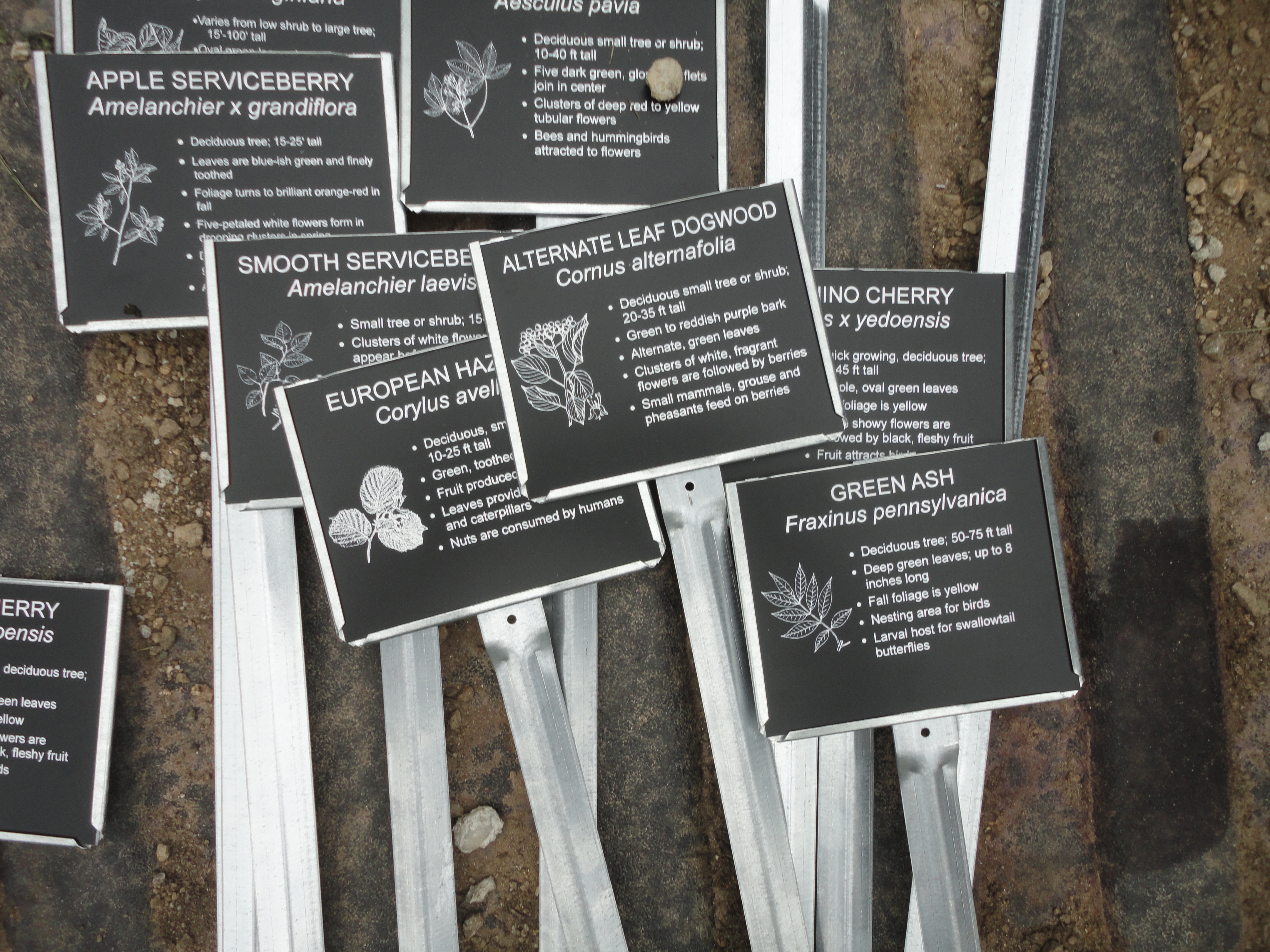
Signs provide Latin and common names and other information

Signs provide Latin and common names and other information

Can you tell one special fact about the Sweetgum tree in front of the Westover Library? Why is the Kentucky Coffeetree at Chestnut Hills Park called that? What’s the difference between a Scarlet Oak and a Pin Oak? Now, it’s a breeze to learn about these trees because they have identification labels at their base.

Each label provides both the scientific Latin and the common name along with some important details. The intended message is that all trees are not alike and there are recognizable details that distinguish one from another. When you know the identity of a tree, you can also learn where it is best planted, and what practical uses it has. We hope these plaques will stimulate interest in trees and, if well received, we will expand to other locations. The general locations for these plaques were based upon the accessibility and popularity of these sites for the public.

Westover - Reed School has all four plaza trees identified.

Westover – Reed School has all four plaza trees identified.

The Westover signs identify the four relatively young trees in the plaza of the Library and Reed School. Check out these trees when you visit the library or during the Sunday Farmers Market, and stop by the TreeStewards information table on the third Sunday of each month. Learn what’s unique about the Red Maple, Dawn Redwood, Burr Oak and Sweetgum.

The Chestnut Hills’ signs are scattered throughout the more visible areas of the Park, focusing on native varieties (species) of Oak trees, five for now with two more planned when playground construction ends. Can you find all these trees and notice their differences? Read the plaques for specific keys to identification and uses of these trees. There is another native Oak species at Chestnut Hills, in a less visible location. Can you find and identify these trees? If you’d like a hint or walk with a TreeSteward, or wish to brag you found all 10 labeled trees, you can reach us through the comments page of this website.

Can you find the Scarlet Oak at Chestnut Hill Park?

Can you find the Scarlet Oak at Chestnut Hill Park?


Worth noting: the Scarlet Oak at Chesnut Hills is the Co-Champion (largest) of its species in Arlington County, and the Kentucky Coffeetree is the second largest of its species. There is also a Tulip Tree in the Park over 15 feet in circumference. What great Parks we have in Arlington!


Finding the Pin Oak takes some searching, but it's worth it.

Finding the Pin Oak takes some searching, but it’s worth it.

The labels were installed by Trees Stewards John Wingard and Don Walsh, with the necessary and able assistance of Parks employee Marco-Antonio Paredes and the help of Parks employees Vincent Verweij and Kevin Stalica in identifying some of the trees and in finalizing locations. Thanks to Trees Virginia for the funding.

Posted in Community Service, Education | Tagged , , , , , | Comments Off on Tree Scavenger Hunts: Westover and Chestnut Hills Park

Sand on the Southern Trees

By Eileen Grant

This past spring, having just finished the Tree Stewards class, I stepped into a new world of trees, especially tree identification.  After the class I couldn’t walk my dog around Alexandria without looking at trees and labeling them… or at least trying to! (That’s a Red, no, a White Oak, that’s some sort of a fruit tree, or maybe not?).  I have my handy tree ID book that I leaf through to figure out what is what. I know I’m driving my husband crazy.

Southern Live Oak's have a mystical beauty.

Southern Live Oak’s have a mystical beauty.

I continued  this in Duck, NC this year with the beautiful trees surrounding the house we stayed in.  I didn’t bring my tree ID book so I used the VTree App on my smart phone. For the twisting green trees surrounding our house the app initially gave me the identification of “Exotic Olive Tree”.  The strange identification showed me how much I have to learn (and how aps don’t always know everything).  I quickly figured that wasn’t correct.

By process of elimination (and a lot of help from the computer) I learned the many trees surrounding our house and neighborhood were Southern Live Oaks. There were thousands of them around Duck (note to self, when there are thousands of trees around chances are they aren’t exotic) and all over Southeastern North America.  Southern Live Oaks, technically classified as Quercus virginiana, are particularly iconic in the Old South, often living past seventy years.

Southern liveoak leavesThe reason it’s called a live oak is because it’s essentially evergreen and doesn’t lose its leaves in the fall thus doesn’t look dead in the winter. The leaves are very different than other oak leaves as well.  They are almost like Holly leaves without the thorny part, also resembling small Magnolia leaves.  They are little, waxy and tough.

They are so wide spread in the Southeastern region because of their deep tap roots that anchor them and on top of that a widespread root system.  This helps them during times of strong winds (surviving hurricanes).  They can also withstand floods but grow well in sandy soils.  They’re also resistant to salt spray. The primary use for these trees is food and shelter for wildlife of all kinds (from butterflies to quail to black bears).  Because the wood is hard and heavy it was used for ships during the wooden ship building years.

Southern Live Oaks make great climbing trees!

Southern Live Oaks make great climbing trees!

The house we rented sat back a good 25 yards from the street and the front yard was a forest of these trees.  They almost looked magical in some light, growing at odd angles and covered with some sort of fungus.  My beach trip this year definitely had a different twist to it because of them.


Posted in Education | Tagged , , | Comments Off on Sand on the Southern Trees

Grate Project Protects Our Street Trees

City trees lead a hard life struggling with tree grates, strangles by light wires, and collecting cigarette butts

City trees lead a hard life struggling with tree grates, strangles by light wires, and collecting cigarette butts

By TreeSteward Richard Fontwengler

In March of this year teams of Tree Stewards fanned out along the Rosslyn-Ballston corridor to inspect street trees growing in planter pits with tree grates.  Arlington County, short on resources to survey the condition of tree grates, requested help in identifying those trees that were having problems living within the often limited space provided by the grates.

Vincent Verweij, Arlington County Urban Forrester, saw this project as a “fantastic educational opportunity for Tree Stewards and a clear assist to the county’s efforts to protect and maintain street trees”.  With the Tree Stewards doing the assessment Arlington could used its limited resources to remedy any problems found and reported by the teams.

Trunk damage caused before grate was enlarged

Trunk damage caused before grate was enlarged

The teams counted and inspected 194 grates in the corridor and found that almost 60% (101) of the grates were found to need attention with 12% (22) overgrowing the grate, 21% (38) touching the grate, 13% (24) had roots lifting the grate, and 14% (27) had grown to within one inch of the grate and would need attention soon.

The findings highlight the potential problems of using grates in the first place.  While they do provide trees with some protection from compacting soil around roots and damage to the base of the trunk, too often they are not monitored and maintained properly.  Also, many of the grates had surprisingly small center holes so if the tree was not planted dead center in the planting pit, or was lucky enough to thrive and grow large, it was doomed to eventually come in contact with the grate.

Tree Stewards were able to see the evolution of tree grate design over the 30 years or so the grates have been used in the Rosslyn-Ballston corridor.  Styles ranged from the traditional heavy cast iron grates to those made of lighter metals or plastic/composites.  Some were more ornamental and some were more functional.  Virtually all the grates we inspected were installed by developers as part of their projects which accounts for the variety of grates found.

An example of a larger soil panel with sectioned grate that is easy to enlarge.

An example of a larger soil panel with sectioned grate that is easy to enlarge.

As a result of the problems we observed with tree grates and the continued threat to girdling and damaging street trees planted within grates, Vincent is now recommending that developers of new projects use simple soil pits without grates for their street tree plantings.  The county is also asking developers to do a better job maintaining their tree pits and street trees after completion of their projects.

Larger spaces are provided for tree roots in the "soil panels" now required
Larger spaces are provided for tree roots in the “soil panels” now required


Armed with the Tree Steward’s spread sheet report, the County Urban Forrester was able to enter the locations of trees/grates that needed attention and/or removal on a map for the maintenance crews.  While some of the grates can be modified to increase the size of the center hole most must be removed when a tree makes contact with the grate.  The crews are working through the list as they have time and most of the offending grates have now been removed.  In one instance the grates were part of a recent development and the developer was asked to do the work.

Large soil panels can also have flowers as a deterrent to walking on tree roots.

Large soil panels can also have flowers as a deterrent to walking on tree roots.

All in all a successful project and a perfect example of Tree Steward volunteers and the county working together in partnership to maintain and protect a most valuable resource:  street trees!

Posted in Community Service, Education, Tree Care | Tagged , | Comments Off on Grate Project Protects Our Street Trees

Arlington National Cemetery Tree Walks

This Deodor cedar (Cedrus deodara) located near the Arlington House dwarfs TreeSteward in it's shade.

This Deodor cedar (Cedrus deodara) located near the Arlington House dwarfs TreeSteward in it’s shade.

Want a perfect way to combine your love of trees and honor our country’s heroes? Take a tree walk on your own or with out of town visitors in the Arlington National Cemetery.  There are more than 8500 trees throughout the 624 acres that provide shad and tranquility, and 140 are marked as memorial trees. Maps identifying the trees are available at the website at http://www.arlingtoncemetery.mil/docs/ANC_Memorial_Map_Trees.pdf.

Labels identify the tree species and provide a history lesson.

Labels identify the tree species and provide a history lesson.

An additional 36 Memorial Trees serve as a living tribute to the nation’s Medal of Honor recipients and each tree is a descendent of a historic tree.  Abraham Lincoln is honored with an Overcup Oak descended from the oak shading the Kentucky home where he was born, a descendent of the Water Oak Helen Keller climbed as a child is planted in her honor, and an American Holly descendent of Mount Vernon honors George Washington.  This tree walk provides a history lesson as well as a chance to identify tree species not often seen in our area. The map is at http://www.arlingtoncemetery.mil/docs/MOH_Memorial_Trees.pdf

ANC Trees and Heroes.  Who can ask for more?

Posted in Education | Tagged | Comments Off on Arlington National Cemetery Tree Walks

Tree Walk at Bon Air Park: Saturday, June 21, 2014

Learn how to tell the difference between red and white oak leaves

Learn how to tell the difference between red and white oak leaves

Come learn about trees — how to identify them, ideas for your yard, maintenance tips and much more.  TreeStewards will be leading walks and answering question at Bon Air Park this coming Saturday, June 21.  Walks will leave at 10 AM and 12:30 PM from the parking lot beside the tennis courts.

Magnolia flower

Which tree has these lovely flowers and will it fit in your yard? Come to the walk!

Bon Air Park is located at 850 N. Lexington St., at the intersection of Wilson Blvd.  The walks are part of the celebration of Master Gardeners and Extension Office 75th Year Anniversary.  Information tables on gardening, pollinators, and natural resources will also be at the park.

Posted in Community Service, Education | Tagged | Comments Off on Tree Walk at Bon Air Park: Saturday, June 21, 2014