After 50 years of reuse and recycling, this artificial tree is green!
‘Tis the season in which many believe the holidays would not be complete without a decorated tree. For those who care about their own environmental impact, the good news is you can follow your traditional celebration with a clear conscious! Just remember the environmental golden rule to Reduce, Reuse, and Recycle whatever your choice. Below are points to consider:
Artificial Trees create a larger carbon imprint at the beginning, yet with yearly reuse and not purchasing new models, this can be spread out over a long time. The tree to the left is basically a wooden pole with green wire bristles from 1960 – so old it is now chic, and holds 50 years of family history. Continue reading →
Doug Tallamy makes it sound sooo easy to plant an acorn and create a tree, so a few Tree Stewards decided to experiment. Here’s what they found.
Nora’s Experience:
First, to determine if the acorns were viable. I checked whether they sunk or floated in a pail of water. As I collected the acorns in the fall, squirrels chattered angrily in the tree. I apologized for removing some of the bounty but there was so much – and a lot of the acorns I found had only one bite taken and discarded, so it’s not like the squirrels were being careful either. The floating test resulted in half of the acorns being put back for the squirrels and other critters. I kept the 20 that had sunk to the bottom.
I decided to start the acorns outside over the winter using an 18 x12x12 deep self- watering planter. The soil was from the back yard under an old compost pile, near site of oak trees so lots of organic material shared by mature oaks were in the soil. Twenty acorns were pushed into the soil just slightly, perhaps half inch of soil on top. The entire top was covered with screen mesh to keep all the moles, mice, squirrels at bay… This worked, but I did enjoy watching one squirrel who wouldn’t give up trying to dig through the screen. I didn’t have to worry about desiccation or severe freezing this last winter and I enjoyed visiting the planter regularly searching for the first break through in the soil.
A collaborative tree planting event in Alexandria by Devon Reese
Volunteers celebrate as City of Alexandria Arborist Phil Jubert sets the last tree – a willow oak – into the ground.
Today was an unusual day in Alexandria’s Mt. Jefferson Park. A four-part collaboration (between the City’s Urban Forestry department, Tree Stewards of Arlington & Alexandria, the Alexandria Beautification Commission and the Arlington Master Naturalists), inspired more than two dozen people to lend a hand in planting trees. By noon, 22 native saplings were in the ground – from dogwoods to white oaks to sweetgums and hackberries.
Tree Stewards of Arlington & Alexandria began a new membership training class in Fall 2024.
Tree Steward trainees are attending a hybrid training of weekly Zoom presentations (conducted live) and in-person field events with experienced Tree Stewards and tree care professionals.
Classes began with an in-person meeting outdoors on Saturday September 7, 2024 and finish October 29, with an in-person graduation gathering on December 7, 2024. In the table below, you can see the class agenda. Field events will occur after the appropriate Zoom class and cover four topics: tree identification, tree planting, tree pruning, and identification and removal of invasive plants.
On a gloriously sunny spring day, Jim McGlone, newly retired from the Virginia Department of Forestry, led 14 volunteers with Tree Stewards of Arlington and Alexandria on a Tree Walk around the grounds of the Lubber Run Community Center on Saturday, May 25. This was part of the continuing education program organized by Continuing Education Chair Paul Kaplowitz. Jim discussed the principles of the right tree in the right place and provided a few examples of the right tree in the wrong place. We learned why bald cypress was a good choice for the grassy slope next to the parking entrance. He then contrasted the landscaped tree plantings around the Community Center, which were planted with input from Tree Stewards, with the trees found in the adjacent urban forest, including majestic tulip trees, black cherries, and American hornbeams. We all learned so much.
Alexandria is hosting its first-ever Eco-City Festival on Saturday, May 11, 2024, from 10 am to 1 pm at NOVA Community College (NVCC), located at 5000 Dawes Avenue, in Alexandria, Virginia. This is a free, family friendly event full of games and activities where people can learn more about environmentally friendly practices happening in our community.
Most notably, to help celebrate Alexandria’s 275th birthday, the Alexandria Beautification Commission is supporting the City’s Urban Forestry department in giving away 275 tree seedlings to spread the green love throughout our vibrant city. As the Tree Stewards of Arlington & Alexandria, we’ll be participating by providing guidance on tree and site selection, demonstrating seedling planting, and a tree planting activity for children.
Tree Selection
The following tree seedling are available to Alexandria residents during the Eco-City Festival. Once you receive your seedling, it’s important to keep the roots moist until you’re able to plant it.
Site Selection
Providing the best environment for your tree to thrive starts with selecting the best location for your tree type. The projected growth size, soil and sunlight needs, ant the distance from structures and power lines all need to be considered. The following resources provide great information to help you select the best place for your new tree.
The seedlings will be small, about 12 inches tall. The great news about seedlings is that they are very easy to plant and the primary requirements are making sure the hole is deep enough and ensuring that they get plenty of water over the next couple of weeks. Make sure the soil is moist but not overly wet. The first video below shows how you can use an empty soda bottle to protect your seedling.
The TreesAreGood website is a great resource for tree care and finding an arborist, when needed. Plant NOVA Trees is another good resource, in both English and Spanish. Several good links can be found on this site, under Tree Care. Once your seedling has a caliper (diameter measured at 6” off the ground) of 1”, you can apply to the Stormwater Utility Fee Credit Program for a credit for planting your tree.
The State of Virginia has required Dominion Energy to deliver electricity from 100% renewable sources by 2045, and as a result there is a push to install solar rooftop panels on houses in our communities. This document presents information relevant to homeowners who have canopy trees but who are also considering the installation of rooftop solar power.
Trees play a large role in our environment. A large canopy tree will sequester carbon; provide stormwater mitigation through avoided surface runoff and rainfall interception; remove air pollutants such as carbon monoxide, ozone and more; create energy savings from shade in summer and wind break in winter; as well as providing safe shelter and food for birds and wildlife. You can quantify the value your trees provide at https://mytree.itreetools.org/#/dashboard
Consider all the ecological and environmental impacts when considering solar panels - it isn’t a tree versus solar situation. You can enjoy energy savings from solar panels while sitting in the shade of your trees listening to bird songs!
Your house plays a role in reducing energy consumption. To reduce the use of fossil fuel energy in your home, the first step is to conduct an energy audit to see if you can realize savings from better insulation and updated appliances. The results will provide information before paying to add solar panels (see https://www.dominionenergy.com/virginia/save-energy/home-energy-assessment).
Rooftop Solar panels assist in reaching 100% renewable electricity. Reducing fossil fuel pollution from generation to its use is another important environmental goal. The potential benefit of rooftop solar for your house can be assessed at https://www.energy.gov/eere/solar/homeowners-guide-going-solar.
Rooftop Solar panels and Trees can coexist. Note that newer, more efficient rooftop panels can work more efficiently with reduced diffuse light so you can retain the tree while realizing some reduction in solar energy output. This is especially important for canopy trees shading your roof in the morning or late afternoon. Consider the following:
A Tree Steward member had to interview three solar panel installation companies before finding one that didn’t want to remove the northern red oak in his front yard. The chosen company noted that the tree would reduce electricity generation to some extent, but the system would still pay for itself. Since installation, the homeowner had an arborist trim a few small limbs that were threatening to grow directly over some panels, but the trimming was less than 1 percent of the tree. After the oak drops its leaves, the panels generate more power than the house uses and the tree steward gets a credit toward future electric bills. This is a win-win: lower utility bills and they still have birds nesting outside their window!
Tree Stewards recommend the following steps:
Perform an energy audit of your house first to help identify the greatest energy and environmental impact.
Interview several solar panel installation companies to find one that is willing to discuss the pros and cons of any large trees impacting energy production, as well as other tree benefits mitigating stormwater and air pollution.
The 85 active members of Tree Stewards of Arlington and Alexandria were very active in 2023, providing almost 4,000 volunteer hours!
Activity Overview:
85 active Tree Stewards
3,882 total hours volunteered
2,846 people educated
8,443 trees assisted
They participated in a diverse range of activities, with nearly half their time spent on tree care in public property.
Project Deep-Dive: Alexandria Planting Fund
One project we’re highlight this year is the Alexandria Planting Fund. Over the course of 2023, Tree Stewards – in partnership with the city of Alexandria and community volunteers – planted over 123 trees:
8 trees in Tarleton Park,
29 trees in and around Ben Brenman Park,
24 trees around Alexandria Animal Shelter,
42 trees in parkland near Lake Cook, Great Waves Water Park, and Eisenhower Avenue Streetscape,
7 trees in parkland surrounding the Duke Street Dog Park, and
13 trees and shrubs around Aldersgate church.
Pictured: Tree Stewards and volunteers from the veterans’ service non-profit “The Mission Continues” plant trees in the City of Alexandria. Photos provided by Bonnie Petry.
But tree planting is not all they do – other popular volunteer activities include public education and new member training, assisting private property owners, and continuing education.
Tree Stewards of Arlington and Alexandria welcomes all citizens who care about trees to join us. For information on training classes, upcoming activities, requesting a Tree Steward speaker, or to comment on trees in your neighborhood, email: treestewardsarlalexva@gmail.com.
The data in this post comes from TrackItForward, our volunteer hour reporting platform. It consists of self-reported data, submitted by Tree Stewards. It was turned into data visualizations by Tree Steward Emily Potosky.
We are all dismayed to see so many trees removed when an old house is torn down and a new one built. Yes, Arlington County has regulations requiring preservation and replanting, yet we wonder if these are sufficiently followed? This summer six Tree Stewards conducted a pilot project of 32 such sites under the direction of Urban Forester Vincent Verweij to determine the answer to this question. The pilot project was so useful, so we plan on repeating it soon.
Yep, that river birch is on plot and they added an extra Magnolia!
The volunteer work was fun and instructive. First, we learned how to read the intricate site plans required at each development so we could tell how many trees should have been conserved, and how many new plantings should have been installed on what spot in the property. Then in pairs we went to that address, knocked on the door, and asked if we could count their trees. Sometimes the homeowner welcomed us, proudly showing off their beautiful trees conserved, planted during development and those they’ve added over the five years! Some were skeptical and refused admittance to the property, and many were not home leaving us to determine how many trees existed on the property from public sidewalks. We must have looked strange to neighbors, wearing our yellow TS vests, standing on tip toe to see over fences, and making notes on clipboard!
The pilot project process will be improved for the next time:
More TS will be recruited and trained for the next survey to be scheduled soon
The reporting sheet has been revised for clearer definitions
An initial letter on TS letterhead describing the project will be sent to all homeowners
information on TS and tree maintenance will be left with each homeowner
The results show good news in that 233 trees have been planted in the last 5 years; however, the unhappy news is that only 46 of the 83 originally conserved old trees on site still survived after 5 years.
A more thorough description of the project and the results are as follows:
In 2018, 320 private properties were developed in Arlington County. The Chesapeake Bay Preservation Ordinance requires a Landscape Conservation Plan for any site disturbance greater than 2,500 sq. ft. Department of Parks and Recreation forestry staff reviews and enforces the requirements of the Landscape Conservation Plan. Residential properties must demonstrate how the site will have 20% forest canopy in twenty years. This can be achieved by using existing trees or trees proposed for planting.
For each of the 320 properties, a site plan was required by the County which showed 1) the trees to be removed due to construction, 2) the trees to remain after construction (conserved trees), and 3) any trees that need to be planted to provide the 20% canopy density after twenty years (planted trees)if the credit for conserving existing trees is not sufficient. Note that this requirement only applies to the development of the property, and legal restrictions to removal of trees after the completion of the development may be limited.
An Anonymous plan sample. Tree Stewards worked from larger originals comparing the plan to the current yard.
A tree survey was conducted in 2023 to ascertain the effectiveness of the 2018 Landscape Conservation Plan. This allowed for five years between site development and the present, which provides information on long-term trends in compliance with the Preservation Ordinance. Ten percent of properties developed in 2018 (32) were randomly selected, and pairs of Arlington County Tree Stewards approached property owners and asked permission to delineate the trees currently on the property. Of the 32 properties visited, 4 were not able to be surveyed because either permission was not granted, or nobody was home on multiple visits and the property could not be assessed from the road.
The results of the survey show that 55% of the conserved trees (i.e., trees present which were to remain according to the site plan) were still present in 2023 (46 of 83 trees), and 86% of the trees that were required to be planted were present in 2023 (117 of 136 required trees). In addition, 163 additional trees were planted; however, many of these were not canopy trees (arbor vitae, crepe myrtle, etc.). In addition, 11% of the properties had more conserved trees than were on the plan (i.e., not all trees slated to be removed were cut down) 14% of the properties had more trees planted than were required in the site plan (an additional 163 trees were planted).
Photos for this blog post were provided by Steve Geiger and Nora Palmatier
Despite its serene name, Ailanthus altissima, more commonly known as Tree of Heaven, is less than a gift from above. A non-native invasive originating in China, Tree of Heaven spreads rapidly, outpacing native plants in its growth and often killing them through chemical secretions in the soil. They also serve as a prime host for another harmful invasive species, the spotted lanternfly.
Unfortunately, mitigating the spread of this plant is not as simple as just cutting down the trees you see. Learn how you can do your part to slow the spread of this pernicious pest.
Identifying Tree of Heaven
Tree of Heaven has several distinctive features. It has bark described as resembling cantaloupe, with long compound leaves that have two distinctive “bumps” or “notches” at the base. The leaves have a distinctive rancid peanut or cat urine-like smell.
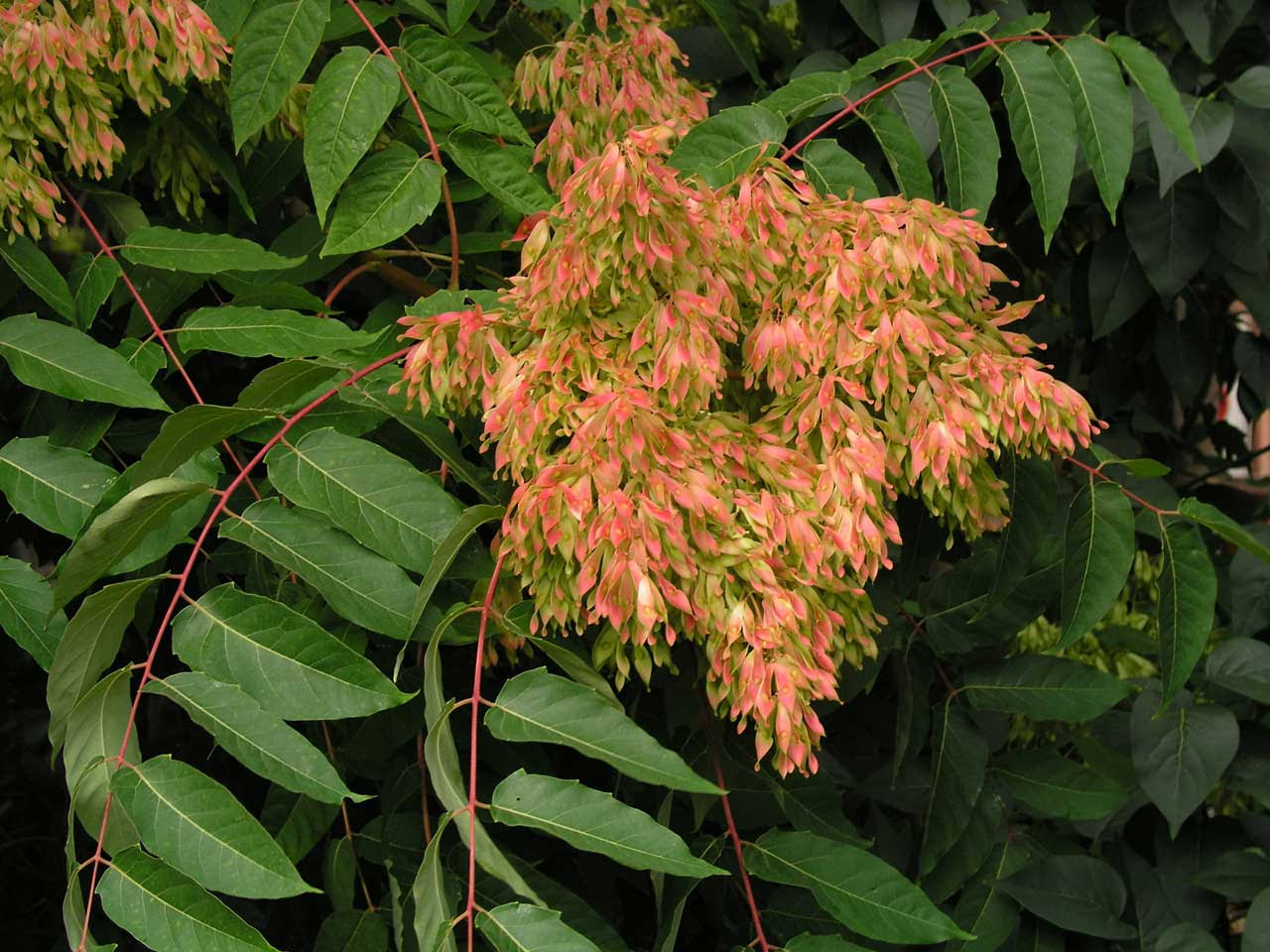
This time of year (late summer to fall) Tree of Heaven is very distinctive, with the female tree sporting peach/salmon/coral colored seeds in clusters.
If you see any mature female trees on public land, particularly in Arlington and Alexandria, please identify them using the iNaturalist application. This will allow local government officials and researchers to track the spread of these trees. When submitting photos of the trees, please submit photos that show the seed clusters, as well as another photo or two that show the characteristic leaves and bark of the tree to ensure accurate tree ID.
Managing Tree of Heaven
As unintuitive as it may seem, cutting down tree of heaven ends up creating a Hydra-like issue: it triggers resprouting from the roots and the stump of the tree, leading to multiple trees taking the place of the original tree.
Only trained staff or contractors should be removing tree of heaven (or any trees!) from public land. For those aiming to mitigate tree of heaven on their private property, you can follow the below steps:
If the tree is still just a seedling/very small sapling that has NOT produced seeds, you can pull the tree out, ensuring all roots are removed. It’s a bit easier to do this after it has rained when the soil is looser.
If the tree is producing seeds and/or is relatively well-established, apply a targeted herbicide, being careful to not apply it to surrounding plants. The two recommended options are:
Basal bark method: Apply a solution of a 20-25% concentration of oil-soluble triclopyr ester product in an oil-based carrier is highly effective. Using a handheld or backpack sprayer, apply the mixture in a continuous 12-inch wide band around the tree base. The basal bark method requires no cutting and is generally used for trees that are less than six inches in diameter, though larger stems (up to 16 inches) may also be treated effectively
Stem injection (hack-and-squirt) method: This technique is very effective when applied during the summer. It requires first making downward-angled cuts into the sapwood around the tree trunk at a comfortable height, using a hand ax. With a spray bottle or wand, squirt the selected product into the cuts within a minute or two, so that the bottom of the cut is covered but the liquid doesn’t run out. This method can be used with trees of any size, though it is most effective with stems over two inches in diameter. A triclopyr product is most often recommended.
Once the tree has died, then you can safely remove it.
Be on the Lookout for the Spotted Lanternfly
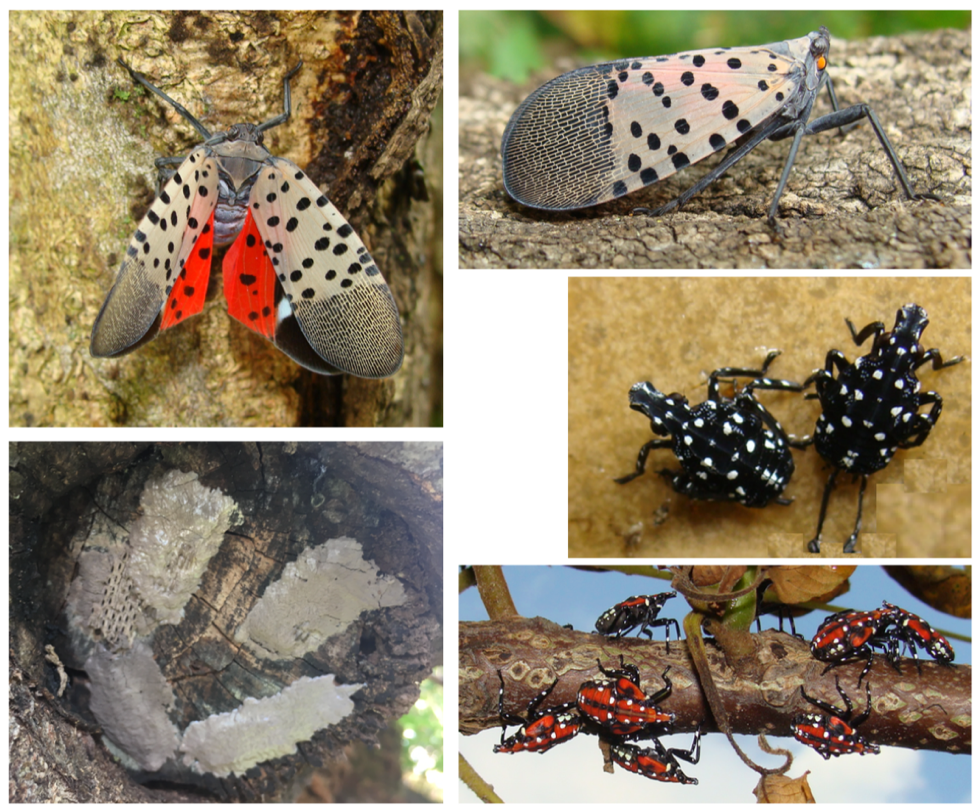
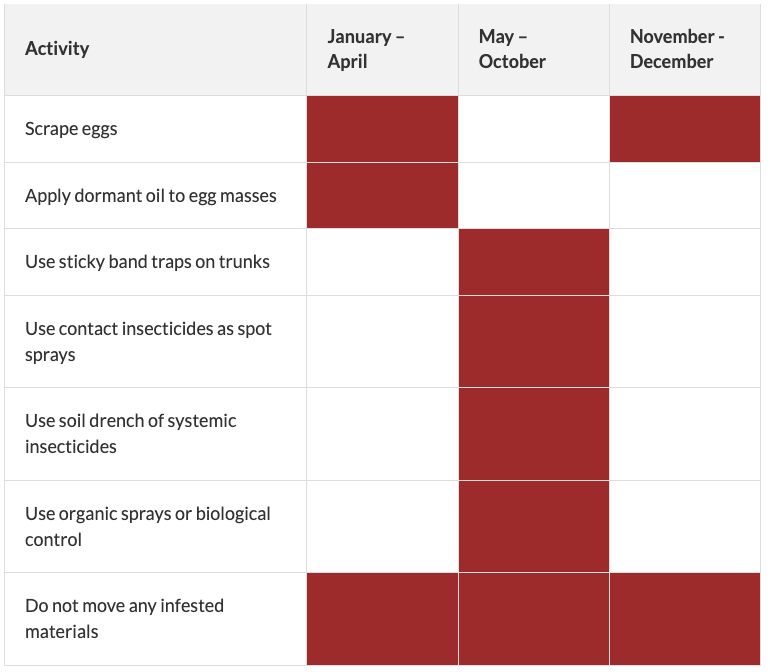
Tree of Heaven is a key host for the spotted lanternfly. Eggs are laid in late fall and can be found on any flat surface such as trailers, logging equipment, and on tree bark. They hatch as “nymphs” in mid-April and become adults in July.
Clockwise from top left: Adult showing hind wings, adult with folded wings, early black and white nymphs, full-grown nymphs showing red, and egg masses.
If you see any spotted lanternflies, please kill nymphs/adults as able, then report the sighting and location with either a photo of the insect or the sample itself to your local Virginia Cooperative Extensive office.